Betriebsstellen/en: Unterschied zwischen den Versionen
Uslex (Diskussion | Beiträge) Die Seite wurde neu angelegt: „*Sample file:“ |
Übernehme Bearbeitung einer neuen Version der Quellseite Markierung: Zurückgesetzt |
||
| Zeile 69: | Zeile 69: | ||
It is stated in the document: [[Medium:TC10Gold Alle Betriebsstellen v2.pdf|TC10Gold Alle Betriebsstellen.pdf]] '''each operating location is discussed individually'''. | It is stated in the document: [[Medium:TC10Gold Alle Betriebsstellen v2.pdf|TC10Gold Alle Betriebsstellen.pdf]] '''each operating location is discussed individually'''. | ||
<div lang="de" dir="ltr" class="mw-content-ltr"> | |||
Zu diesem Dokument gehört auch eine TC-Datei. Archiv (Zip-Datei): | |||
</div> [[Medium:Projekt TC10B1 alle BS V3.zip|Projekt TC10B1 alle BS V3.zip]] | |||
== Weblinks == | == Weblinks == | ||
Version vom 15. Januar 2025, 17:39 Uhr
| Verwendung |

|
Operating locations
Two categories of operating locations

- Fig: Operating points

The operating points can be divided into two categories, even if this is not stated in the official documentation.
Active operating points move the trains within the operating point itself. In addition to the block in which coupling (uncoupling) takes place (marked in red), these require additional blocks.
Passive operating points only intervene in the ongoing train operation in a controlling or regulating manner or operate locomotive functions (e.g. tunnels).
Active operating points
- Shadow station
- Locomotive shed
- Shuttle track
- Locomotive change
- Pushing operation
- Shut-off hump
Passive operating points
- Station
- Single-track line
- Single-track operation
- Slow speed section
- Tunnel
- Junction
- Exit
- Siding point
- Shunting area
- Storage area
- Quantity control
- Booster
- Display case
Prerequisite
A fully configured block is required so that the first train arriving can stop at the desired location.
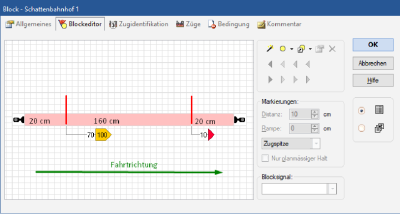
- Fig: Block Schattenbahnhof

Special marking
The special marking is used at some operating points. This is always required when a second train or a second locomotive is to enter a block that has already been reserved (by other vehicles).
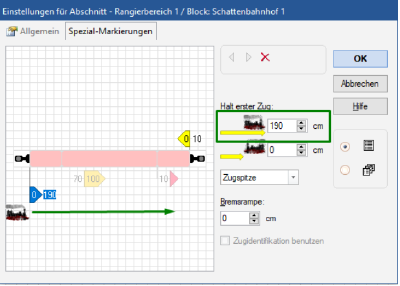
- Fig: Special marking

Download instructions
It is stated in the document: TC10Gold Alle Betriebsstellen.pdf each operating location is discussed individually.
Zu diesem Dokument gehört auch eine TC-Datei. Archiv (Zip-Datei):
Weblinks
- Source: Forum
- Directions: TC10Gold Alle Betriebsstellen.pdf
- Sample file: Projekt TC10B1 alle BS V3.zip
- -- Silvio Richter 19. Dez. 2023 (UTC)
- bearbeitet: Uslex (Diskussion) 07:49, 20. Dez. 2023 (UTC)