Rollenprüfstand/en: Unterschied zwischen den Versionen
Uslex (Diskussion | Beiträge) Die Seite wurde neu angelegt: „µCon Railspeed definitely works with TrainController 9. You also need to download the "Railspeed Data Copy Tool for TrainController 9 Gold" (RDCT) software from LSDigital's download section [https://www.lsdigital-shop.de/download/]. This tool runs alongside TrainController and receives the data from µCon Railspeed, copying it to the Windows clipboard, from where TrainController then retrieves the data.“ |
Uslex (Diskussion | Beiträge) Die Seite wurde neu angelegt: „=== Zeller roller test benches from TC 9 ===“ |
||
| Zeile 42: | Zeile 42: | ||
µCon Railspeed definitely works with TrainController 9. You also need to download the "Railspeed Data Copy Tool for TrainController 9 Gold" (RDCT) software from LSDigital's download section [https://www.lsdigital-shop.de/download/]. This tool runs alongside TrainController and receives the data from µCon Railspeed, copying it to the Windows clipboard, from where TrainController then retrieves the data. | µCon Railspeed definitely works with TrainController 9. You also need to download the "Railspeed Data Copy Tool for TrainController 9 Gold" (RDCT) software from LSDigital's download section [https://www.lsdigital-shop.de/download/]. This tool runs alongside TrainController and receives the data from µCon Railspeed, copying it to the Windows clipboard, from where TrainController then retrieves the data. | ||
< | <span id="Zeller_Rollenprüfstände_ab_TC_9"></span> | ||
=== Zeller | === Zeller roller test benches from TC 9 === | ||
<div lang="de" dir="ltr" class="mw-content-ltr"> | <div lang="de" dir="ltr" class="mw-content-ltr"> | ||
Version vom 27. Juli 2026, 15:02 Uhr
| Verwendung |

|
Calibrate the locomotive with the roller test bench
Physics - Roller Test Benches
First and foremost, physics: Even with load-controlled decoders, the physical properties of the vehicles must not be ignored.
On the roller test stand, the physical mass/inertia has virtually no influence on the measurement result, since the locomotive mass (i.e. the locomotive weight) does not have to be set in motion on the test stand.
On the measuring track, however, it is different: Here, the inertia of the mass must be overcome during the measuring process so that the locomotive can even start moving in the first place.
Therefore, it is reasonable to assume that the locomotives run faster on a roller test stand than on the rails, even if everything is identical from an electrical point of view.
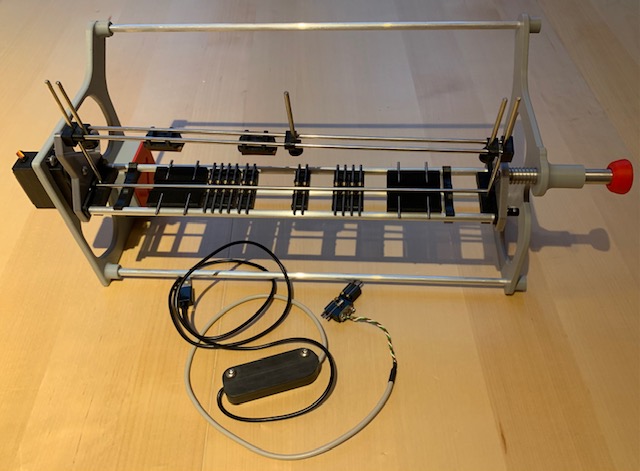
- Fig.: Roller test bench

- Michael Mertner described the pros and cons in pros and cons.pdf in this post.
TrainController from version 9
From version 9 onwards, TrainController offers a general, hardware- and manufacturer-independent interface that can be used conversely by the various measurement systems.
- Mr. Freiwald writes about this in this post:
Since version 9, virtually any roller test bench and other measuring system that offers a PC interface can be used for calibration. A return to limiting support to just a few roller test benches, as in version 8, is certainly no longer practical.
However, we no longer expend a great deal of effort for each individual system to program a special adaptation to the respective PC interface of that system.
Instead, we take advantage of the fact that manufacturers of such systems already have (or are required to have) software that fully operates their own PC interface and can display measured values. Without such software, the manufacturers would not have been able to test their own PC interface before releasing it.
Starting with version 9, TrainController offers an automated measurement procedure where measured speeds are copied to the Windows clipboard during the calibration process. Manufacturers of measurement systems simply need to extend their existing software to write the measured or displayed values to the clipboard. This can be done with fewer than 10 lines of code. And if you don't know how, you can find countless code examples online in all common programming languages.
µCon Railspeed from TC 9
µCon Railspeed definitely works with TrainController 9. You also need to download the "Railspeed Data Copy Tool for TrainController 9 Gold" (RDCT) software from LSDigital's download section [1]. This tool runs alongside TrainController and receives the data from µCon Railspeed, copying it to the Windows clipboard, from where TrainController then retrieves the data.
Zeller roller test benches from TC 9
Auch die Rollenprüfstände von KPF-Zeller funktionieren mit TrainController 9. Man muss sich zusätzlich die Software "SpeedCat PLUS" als ZIP im Downloadbereich von der Webseite der Firma KPF-Zeller herunterladen und parallel zum TrainController installieren.
TrainController bis Version 8
TrainController 7 und 8 unterstützt das Einmessen der Loks mittels Rollenprüfständen. Allerdings sind dabei ein paar Feinheiten zu beachten.
RAILROAD.INI für TC 7 und 8
In TrainController direkt gibt es keine Konfigurationsmöglichkeiten für die Rollenprüfstände. Ab TrainController 7.0 F3 können diese Einstellungen vielmehr in der Datei RAILROAD.INI vorgenommen werden. Je nach verwendeter Windows-Version ist diese Datei allerdings nicht immer leicht zu finden:
- Windows 7 mit aktiven Benutzerkonten:
- C:\Users\UserName\AppData\Local\VirtualStore\Program Files (x86)\Railroad & Co.80
- Windows 7 ohne Benutzerkonten, ältere Windows-Versionen:
- C:\Program Files (x86)\Railroad & Co.80
Im Abschnitt [Connections] ist ein entsprechender Eintrag zu ergänzen.
Zeller Rollenprüfstände und TC 8
Für die Prüfstände der Firma Marion Zeller gibt es eine Option für die verschiedenen Maßstäbe. In der Online-Programmhilfe findet sich dazu folgender Eintrag:
ZellerDiameter
Setzen Sie diesen Wert auf xxx, wobei xxx den Durchmesser der Rolle angibt in Hundertstel-Millimetern. Die Voreinstellung ist ZellerDiameter=593, was für einen Rollen-Durchmesser von 5,93 mm passt.
Die folgenden Werte zeigen Beispiele für die verschiedenen Prüfstände der Fa. Marion Zeller:
- 610: 6,10 mm für Spur H0, 0 und 1
- 475: 4,75 mm für Spur N
- 580: 5,80 mm für Spur TT
Beispiel:
[Connections]
ZellerDiameter=475
Die Firma KPF-Zeller hat für seine Speed-Cat einen neuen Drehgeber herausgebracht. Der Präzisions-Drehgeber hat die 4-fache Auflösung gegenüber dem Standard-Drehgeber der Speed-Cat und soll ein präziseres einmessen bei geringeren Geschwindigkeiten ermöglichen. Daher ist der Wert der Voreinstellung (593) nicht mehr zutreffend, sondern muß durch 4 geteilt werden:
Beispiel:
[Connections]
ZellerDiameter=148
Weblinks
- Quelle: Forum
- Pro und Kontra: Einmessen_mit_Lichtschranke_kontra_Messtrecke.pdf
- µCon Railspeed: Downloadbereich
- Zeller Rollenprüfstand: Downloadbereich
- --Digi thomas2003 16:36, 6. Jan. 2015 (CET)
- redaktionelle Kontrolle: Wohlmannstetter 18:13, 7. Mär. 2021 (CET)
- Unterschiede TC7,8 zu TC 9,10: Uslex 12:00, 14. Sep. 2021 (CEST), Uslex (Diskussion) 13:41, 19. Dez. 2025 (UTC)