Spontanfahrt mit zufälligem Halt/en: Unterschied zwischen den Versionen
Uslex (Diskussion | Beiträge) Die Seite wurde neu angelegt: „=== Define variable in time ===“ |
Uslex (Diskussion | Beiträge) Die Seite wurde neu angelegt: „Silvio Richter describes the solution in the [https://www.freiwaldsoftware.de/forum/viewtopic.php?p=281039#p281039 forum]:“ |
||
| Zeile 28: | Zeile 28: | ||
=== Define variable in time === | === Define variable in time === | ||
Silvio Richter describes the solution in the [https://www.freiwaldsoftware.de/forum/viewtopic.php?p=281039#p281039 forum]: | |||
Silvio Richter | |||
<div lang="de" dir="ltr" class="mw-content-ltr"> | <div lang="de" dir="ltr" class="mw-content-ltr"> | ||
Version vom 8. April 2026, 16:55 Uhr
| Verwendung |

|
Spontaneous trip with a random stop
Train should not always stop
The idea is not that every train should stop, but rather that trains should stop at random.
Insert time variable
I created a global variable of type Number. Then the variable "Stay_Random" is assigned a starting value of 0.
There is a 50% probability that it will be increased to 7000 (7000 milliseconds = 7 seconds).
This variable is then entered as the length of stay.
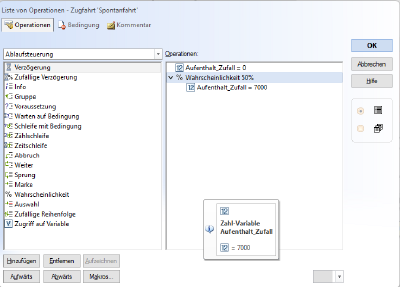
- Fig: Random stop - spontaneous trip

Problem: The result was that the test locomotive always stopped one lap later, even though (according to the variable monitor) the value of the variable was 7000.
Define variable in time
Silvio Richter describes the solution in the forum:
Es ist egal, mit welchen Mitteln (Makro, Abschnittseinstellungen etc) der Variablenwert eingestellt wird.
Zu beachten ist, dass der Wert feststehen muss, bevor der Block mit dem variablen Aufenthalt reserviert wird. Bei einer Reservierungslanze von 2 ist also der Wert 3 Blöcke vor dem Aufenthalt einzustellen.
Oder anders: Es wird der Wert genutzt, der im Moment der Reservierung des Blockes aktuell ist.
Weblinks
- Quelle: Forum
- TC-wiki: Variable Aufenthaltsdauer
- -- Uslex 16:19, 8. Apr. 2026 (CEST)